


Page 148 - SREENARAYANAGURU OPEN UNIVERSITY
P. 148
vidual  letters  and  characters  could  be  rear-  not mix. The image is first drawn or transferred
               ranged to form words and sentences, was first  onto a flat surface, typically a limestone block
               developed in China in the 11th century and  or a metal plate. The surface is then coated
               later in Europe in the 15th century by Johannes  with a mixture of gum arabic and nitric acid,
               Gutenberg.                                     which makes the image water-repellent. Ink is
                                                              then applied to the surface, which adheres to
                  In the 19th century, the invention of lithog-  the image but not the surrounding areas.
               raphy by Alois Senefelder enabled the print-
               ing of high-quality images and text using a      The surface is then dampened with water,
               flat stone or metal plate. The invention of the  absorbed by the non-image areas. This cre-
               printing press revolutionised the production  ates a barrier between the ink and the non-im-
               of books and other printed materials, enabling  age areas, preventing the ink from spreading
               mass production on a scale that was previously  beyond the intended image area. The ink is
               impossible. This led to an explosion in liter-  then transferred onto paper, either by press-
               acy rates and spreading knowledge and ideas  ing the paper onto the surface or by passing it
               throughout Europe and beyond. Lithography  through a press.
               is based on the principle that water and oil do


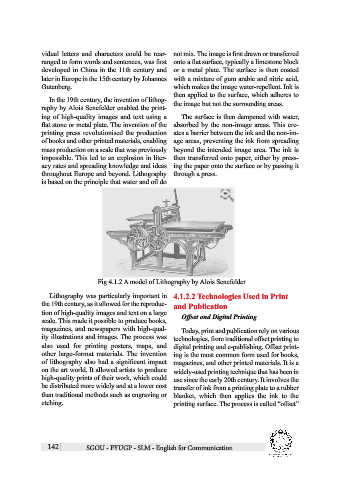
                                   Fig 4.1.2 A model of Lithography by Alois Senefelder

                  Lithography was particularly important in  4�1�2�2 Technologies Used in Print
               the 19th century, as it allowed for the reproduc-  and Publication
               tion of high-quality images and text on a large
               scale. This made it possible to produce books,   Offset and Digital Printing
               magazines, and newspapers with high-qual-        Today, print and publication rely on various
               ity illustrations and images. The process was   technologies, from traditional offset printing to
               also  used  for  printing  posters,  maps,  and   digital printing and e-publishing. Offset print-
               other  large-format  materials.  The  invention   ing is the most common form used for books,
               of lithography also had a significant impact   magazines, and other printed materials. It is a
               on the art world. It allowed artists to produce   widely-used printing technique that has been in
               high-quality prints of their work, which could   use since the early 20th century. It involves the
               be distributed more widely and at a lower cost   transfer of ink from a printing plate to a rubber
               than traditional methods such as engraving or   blanket,  which  then  applies  the  ink  to  the
               etching.                                       printing surface. The process is called “offset”


                 142           SGOU - FYUGP - SLM - English for Communication

