


Page 114 - SREENARAYANAGURU OPEN UNIVERSITY
P. 114
For example, a study is conducted to identify the job satisfaction
                                           of an employee  in an organisation. Here, the respondents are
                                           asked to classify 20 statements based on job satisfaction such as
                                           statements relating to job security, remuneration, opportunities for
                                           career growth and so forth into five piles from ‘Highly satisfied’
                                           to ‘Highly dissatisfied’. Generally, the most agreed statement is
                                           placed on the top while the least agreed statement at the bottom.

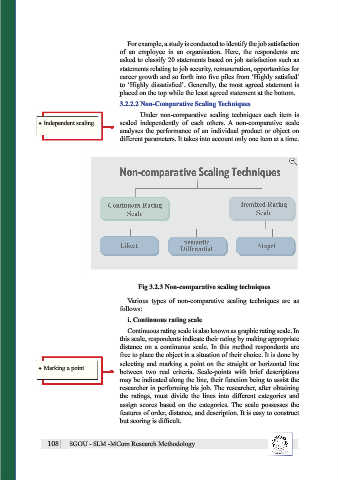
                                           3.2.2.2 Non-Comparative Scaling Techniques
                                                  Under  non-comparative  scaling  techniques  each  item  is
                  ◆ Independent scaling    scaled independently of each others.  A non-comparative  scale
                                           analyses the performance of an individual product or object on
                                           different parameters. It takes into account only one item at a time.


                                                 Fig 3.2.3 Non-comparative scaling techniques

                                             Various  types  of  non-comparative  scaling  techniques  are  as
                                           follows:
                                             i. Continuous rating scale
                                             Continuous rating scale is also known as graphic rating scale. In
                                           this scale, respondents indicate their rating by making appropriate
                                           distance on a continuous scale. In this method respondents are
                                           free to place the object in a situation of their choice. It is done by
                                           selecting and marking a point on the straight or horizontal line
                 ◆ Marking a point
                                           between two real criteria.  Scale-points  with brief descriptions
                                           may be indicated along the line, their function being to assist the
                                           researcher in performing his job. The researcher, after obtaining
                                           the  ratings,  must  divide  the  lines  into  different  categories  and
                                           assign scores based on the categories.  The scale  possesses the
                                           features of order, distance, and description. It is easy to construct
                                           but scoring is difficult.


                 108     SGOU - SLM -MCom Research Methodology

