


Page 62 - SREENARAYANAGURU OPEN UNIVERSITY
P. 62
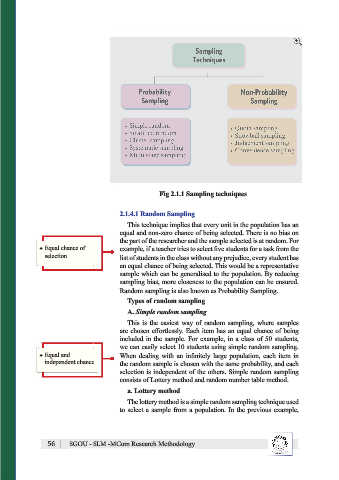
Fig 2.1.1 Sampling techniques


                                           2.1.4.1 Random Sampling
                                              This technique implies that every unit in the population has an
                                           equal and non-zero chance of being selected. There is no bias on
                                           the part of the researcher and the sample selected is at random. For
                  ◆ Equal chance of        example, if a teacher tries to select five students for a task from the
                selection                  list of students in the class without any prejudice, every student has
                                           an equal chance of being selected. This would be a representative
                                           sample which can be generalised to the population. By reducing
                                           sampling bias, more closeness to the population can be ensured.
                                           Random sampling is also known as Probability Sampling.

                                              Types of random sampling
                                              A. Simple random sampling

                                              This is the easiest way of random sampling, where samples
                                           are chosen effortlessly. Each item has an equal chance of being
                                           included in the sample. For example, in a class of 50 students,
                                           we can easily select 10 students using simple random sampling.
                  ◆ Equal and              When dealing  with  an infinitely large  population, each item in
                independent chance         the random sample is chosen with the same probability, and each
                                           selection is independent of the others. Simple random sampling
                                           consists of Lottery method and random number table method.
                                              a. Lottery method

                                              The lottery method is a simple random sampling technique used
                                           to select a sample from a population. In the previous example,


                 56      SGOU - SLM -MCom Research Methodology

