


Page 106 - SREENARAYANAGURU OPEN UNIVERSITY
P. 106
Discussion


                                           3.2.1 Scaling

                                             A common feature  of survey based research is to convert
                                           respondent’s  feelings,  attitudes,  opinions,  etc.  into  measurable
                                           terms. Scaling describes the procedures of assigning numbers to
                                           various degrees of opinion, attitude and other concepts. Scaling
                                           originated in the social sciences in an attempt to measure or to
                                           classify  attributes  by  quantitative  methods.  Scaling  provides
                                           a mechanism for measuring abstract concepts. Scales of
                                           measurement in statistics are different ways in which variables
                  ◆ Group variables in a
                continuum                  are grouped to different categories. It describes the nature of the

                                           values  assigned to the data set variables. A scale is a continuum,
                                           consisting of the highest point (in terms of some characteristic
                                           e.g., preference, favourableness, etc.) and the lowest point along
                                           with several intermediate points between these two extreme
                                           points. These scale-point positions are so related to each other that
                                           when the first point happens to be the highest point, the second
                                           point indicates a higher degree in terms of a given characteristic as
                                           compared to the third point and the third point indicates a higher
                                           degree as compared to the fourth and so on.


                                           3.2.2 Types of Scales

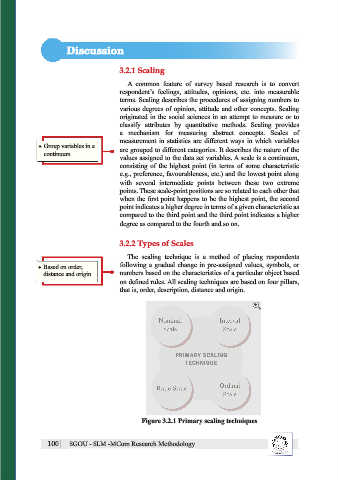
                                             The  scaling  technique  is  a  method  of  placing  respondents
                 ◆ Based on order,         following a gradual change in pre-assigned values, symbols, or
                distance and origin        numbers based on the characteristics of a particular object based
                                           on defined rules. All scaling techniques are based on four pillars,
                                           that is, order, description, distance and origin.


                                                  Figure 3.2.1 Primary scaling techniques


                 100     SGOU - SLM -MCom Research Methodology

