


Page 82 - SREENARAYANAGURU OPEN UNIVERSITY
P. 82
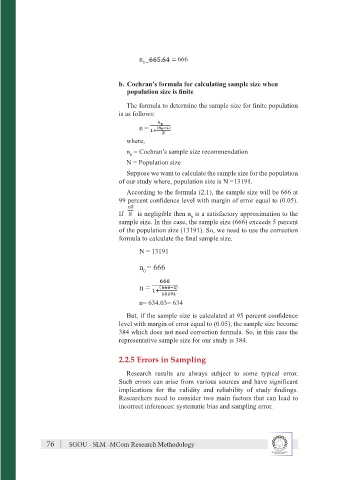
n 0 =        666


                                           b. Cochran’s formula for calculating sample size when
                                              population size is finite

                                             The formula to determine the sample size for finite population
                                           is as follows:

                                                  n =

                                             where,
                                             n  = Cochran’s sample size recommendation
                                               0
                                             N = Population size

                                             Suppose we want to calculate the sample size for the population
                                           of our study where, population size is N =13191.
                                             According to the formula (2.1), the sample size will be 666 at
                                           99 percent confidence level with margin of error equal to (0.05).

                                           If     is negligible then n  is a satisfactory approximation to the
                                                                    0
                                           sample size. In this case, the sample size (666) exceeds 5 percent
                                           of the population size (13191). So, we need to use the correction
                                           formula to calculate the final sample size.

                                                  N = 13191

                                                  n = 666
                                                   0

                                                  n =

                                                  n= 634.03= 634

                                             But, if the sample size is calculated at 95 percent confidence
                                           level with margin of error equal to (0.05), the sample size become
                                           384 which does not need correction formula. So, in this case the
                                           representative sample size for our study is 384.


                                           2.2.5 Errors in Sampling

                                             Research  results  are  always  subject  to  some  typical  error.
                                           Such errors can arise from various sources and have significant
                                           implications  for  the  validity  and  reliability  of  study  findings.
                                           Researchers need to consider two main factors that can lead to
                                           incorrect inferences: systematic bias and sampling error.


                 76      SGOU - SLM -MCom Research Methodology

