


Page 80 - SREENARAYANAGURU OPEN UNIVERSITY
P. 80
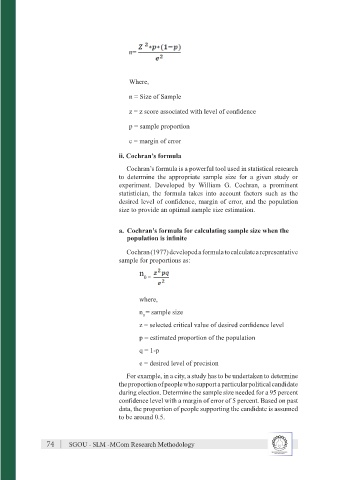
n=


                                              Where,

                                              n = Size of Sample

                                              z = z score associated with level of confidence


                                              p = sample proportion

                                              e = margin of error

                                           ii. Cochran’s formula

                                             Cochran’s formula is a powerful tool used in statistical research
                                           to  determine  the  appropriate  sample  size  for a given  study or
                                           experiment.  Developed  by  William  G. Cochran,  a prominent
                                           statistician,  the  formula  takes  into  account  factors  such  as  the
                                           desired level of confidence, margin of error, and the population
                                           size to provide an optimal sample size estimation.


                                           a.  Cochran’s formula for calculating sample size when the
                                              population is infinite

                                             Cochran (1977) developed a formula to calculate a representative
                                           sample for proportions as:
                                                  n
                                                    0 =


                                                  where,

                                                  n = sample size
                                                   0
                                                  z = selected critical value of desired confidence level

                                                  p = estimated proportion of the population

                                                  q = 1-p
                                                  e = desired level of precision

                                             For example, in a city, a study has to be undertaken to determine
                                           the proportion of people who support a particular political candidate
                                           during election. Determine the sample size needed for a 95 percent
                                           confidence level with a margin of error of 5 percent. Based on past
                                           data, the proportion of people supporting the candidate is assumed
                                           to be around 0.5.


                 74      SGOU - SLM -MCom Research Methodology

