


Page 97 - SREENARAYANAGURU OPEN UNIVERSITY
P. 97
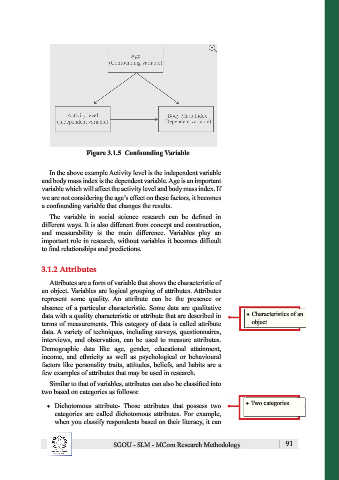
Figure 3.1.5  Confounding Variable


                  In the above example Activity level is the independent variable
               and body mass index is the dependent variable. Age is an important
               variable which will affect the activity level and body mass index. If
               we are not considering the age’s effect on these factors, it becomes
               a confounding variable that changes the results.
                  The  variable  in  social  science  research  can  be  defined  in
               different ways. It is also different from concept and construction,
               and  measurability  is  the  main  difference.  Variables  play  an
               important role in research, without variables it becomes difficult
               to find relationships and predictions.


               3.1.2 Attributes

                  Attributes are a form of variable that shows the characteristic of
               an object. Variables are logical grouping of attributes. Attributes
               represent  some  quality.  An  attribute  can  be  the  presence  or
               absence of a particular characteristic. Some data are qualitative
               data with a quality characteristic or attribute that are described in      ◆ Characteristics of an
               terms of measurements. This category of data is called attribute          object
               data. A variety of techniques, including surveys, questionnaires,
               interviews, and observation, can be used to measure attributes.
               Demographic  data  like  age,  gender,  educational  attainment,
               income,  and ethnicity  as well  as psychological  or behavioural
               factors like personality traits, attitudes, beliefs, and habits are a
               few examples of attributes that may be used in research.
                  Similar to that of variables, attributes can also be classified into
               two based on categories as follows:

                    ◆ Dichotomous  attribute-  Those attributes  that  possess two        ◆ Two categories
                    categories  are  called  dichotomous  attributes.  For example,
                    when you classify respondents based on their literacy, it can


                                         SGOU - SLM - MCom Research Methodology                      91

