


Page 103 - SREENARAYANAGURU OPEN UNIVERSITY
P. 103
•  What are their needs?                       or it can be a large public audience. An import-
                                                              ant feature of the audience in public speaking
                  Now what are the benefits of understanding   situations is the unequal distribution of speak-
               the audience? When you are speaking you want   ing time. The speaker here talks a lot and the
               the listeners to understand and respond favour-  audience listen, often without asking questions
               ably to what you are saying. An audience is    or responding with any feedback. On some
               a group of people who assemble together to     occasions the audience may ask questions or
               listen to the speaker. The audience can com-   respond to the speaker by making comments.
               municate face to face with the speaker or they
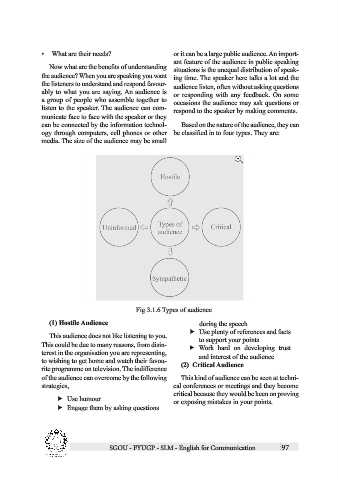
               can be connected by the information technol-     Based on the nature of the audience, they can
               ogy through computers, cell phones or other  be classified in to four types. They are:
               media. The size of the audience may be small


                                                 Fig 3.1.6 Types of audience

                  (1) Hostile Audience                                 during the speech
                                                                   f   Use plenty of references and facts
                  This audience does not like listening to you.        to support your points
               This could be due to many reasons, from disin-      f   Work  hard  on  developing  trust
               terest in the organisation you are representing,        and interest of the audience
               to wishing to get home and watch their favou-    (2)  Critical Audience
               rite programme on television. The indifference
               of the audience can overcome by the following    This kind of audience can be seen at techni-
               strategies,                                    cal conferences or meetings and they become
                                                              critical because they would be keen on proving
                     f   Use humour                           or exposing mistakes in your points.
                     f   Engage them by asking questions


                                       SGOU - FYUGP - SLM - English for Communication               97

