


Page 165 - SREENARAYANAGURU OPEN UNIVERSITY
P. 165
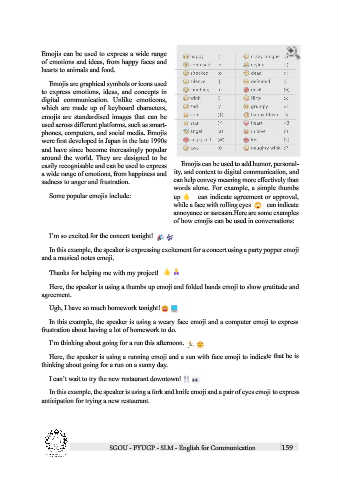
Emojis can be used to express a wide range
               of emotions and ideas, from happy faces and
               hearts to animals and food.

                  Emojis are graphical symbols or icons used
               to express emotions, ideas, and concepts in
               digital  communication.  Unlike  emoticons,
               which are made up of keyboard characters,
               emojis  are  standardised  images  that  can  be
               used across different platforms, such as smart-
               phones, computers, and social media. Emojis
               were first developed in Japan in the late 1990s
               and have since become increasingly popular
               around  the  world. They  are  designed  to  be
               easily recognisable and can be used to express   Emojis can be used to add humor, personal-
               a wide range of emotions, from happiness and   ity, and context to digital communication, and
               sadness to anger and frustration.              can help convey meaning more effectively than
                                                              words alone. For example, a simple thumbs
                  Some popular emojis include:                up       can indicate agreement or approval,
                                                              while a face with rolling eyes     can indicate
                                                              annoyance or sarcasm.Here are some examples
                                                              of how emojis can be used in conversations:


                  I’m so excited for the concert tonight!

                  In this example, the speaker is expressing excitement for a concert using a party popper emoji
               and a musical notes emoji.

                  Thanks for helping me with my project!

                  Here, the speaker is using a thumbs up emoji and folded hands emoji to show gratitude and
               agreement.
                  Ugh, I have so much homework tonight!

                  In this example, the speaker is using a weary face emoji and a computer emoji to express
               frustration about having a lot of homework to do.

                  I’m thinking about going for a run this afternoon.

                  Here, the speaker is using a running emoji and a sun with face emoji to indicate that he is
               thinking about going for a run on a sunny day.

                  I can’t wait to try the new restaurant downtown!

                  In this example, the speaker is using a fork and knife emoji and a pair of eyes emoji to express
               anticipation for trying a new restaurant.


                                       SGOU - FYUGP - SLM - English for Communication               159

