


Page 38 - SREENARAYANAGURU OPEN UNIVERSITY
P. 38
Reading can be silent or loud based on the    Language  is  a  storehouse  of  knowledge
               purpose. If you are reading for yourself, it can  with different kinds of production and recep-
               be silent reading, and if you are reading loud  tion. In the language use, writing is the act of
               it is oral reading. News readers practise oral  combining  symbols  into  meaningful  words
               reading. It is also informational reading, as  and sentences. Symbols are arranged in cer-
               they read to provide informations.             tain conventions to form words. These words
                                                              represent thoughts and expressions into mean-
                     f   Sometimes  you  read  a  page  or    ingful forms.
                        data to get a particular informa-
                        tion, which is called scanning.         Good  writing  skills  by  converting  them
                     f   Skimming involves a quick run-       allow you to communicate with clarity and
                        ning over the text to get the es-     ease. Through it, the message would be con-
                        sence out of it.                      veyed clearly. Continuous learning and prac-
                  The following are some factors to overcome  tice makes you a proficient writer.  Writing
               your reading problems.                         skills are not static but dynamic. It includes a
                                                              mechanical process. The words can be written
                     f   Practise reading.                    by hand or typed. In both, the spelling should
                     f   Recognise  unfamiliar  words  and    be correct and proper punctuation should be
                        understand the literal and contex-    used.
                        tual meaning.
                     f   Understand the unfamiliar words        If the handwritten copy is not readable, the
                        with the help of a teacher or a dic-  message cannot be decoded. Similarly, if the
                        tionary.                              spellings are misplaced or wrong, the meaning
                     f   Develop linguistic competence.       may change. The tone of the text is also very
               1�3�4 Writing                                  important. The punctuation should be correctly
                  “Reading maketh a full man; conference a    placed; otherwise the meaning can be misread.
               ready man; and writing an exact man,” says       Writing should be legible and logical. The
               Francis-Bacon, the 16  century essayist.  A    written communication or addresses a larger
                                      th
               speech  may  be  forgotten  later,  if  it’s  not   group of audience than face to face or tele-
               recorded, but writing and documenting is a     phonic  conversations. The  prior  knowledge
               record forever. The literary works of the past   and  expertise  in  vocabulary  will  help  you
               were recorded so that we read them in the pres-  imminently in the writing process.
               ent age. Writing provides physical evidence of
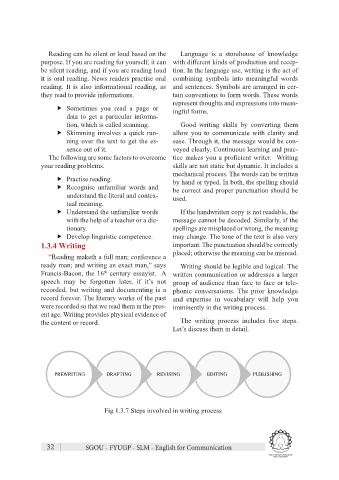
               the content or record.                           The  writing  process  includes  five  steps.
                                                              Let’s discuss them in detail.


                    PREWRITING        DRAFTING          REVISING          EDITING         PUBLISHING


                                      Fig 1.3.7 Steps involved in writing process


                 32            SGOU - FYUGP - SLM - English for Communication

