


Page 54 - SREENARAYANAGURU OPEN UNIVERSITY
P. 54
Discussion                                       An active listener can improve his/her lis-
               2�1�1 Learning to Listen                       tening  skills  with  practice,  which  will  also
                                                              improve his/her interpersonal relationships. If
                  We hear many things, but most of them just  you practice active listening, it will also allow
               pass through us. As the saying goes, it enters  you to recollect and retrieve important infor-
               through one ear and exits through the other.  mation readily.
               When that happens, we are involved in pas-
               sive listening. We assume that our brain will    An  active  listener    concentrates  on  the
               capture the important part and that we will be   speaker  and shows curiosity in the conver-
               able to reproduce it later, whenever needed.   sation.  He/she  will  convey  response  to  the
               This is not always the case and a lot gets lost   speaker as well. In interpersonal communica-
               in communication. To ensure effective commu-   tion, being a good listener is important. It will
               nication, active listening is crucial.         also help to improve your leadership qualities.


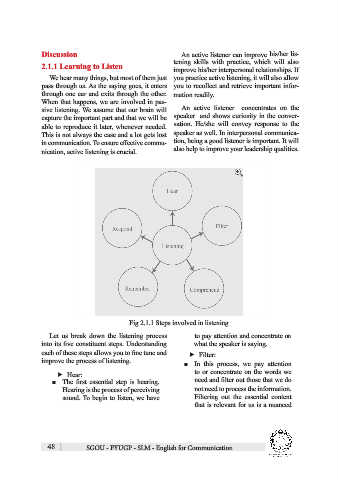
                                              Fig 2.1.1 Steps involved in listening

                  Let  us  break  down  the  listening  process      to pay attention and concentrate on
               into its five constituent steps. Understanding        what the speaker is saying.
               each of these steps allows you to fine tune and     f   Filter:
               improve the process of listening.                     In  this  process,  we  pay  attention

                     f   Hear:                                       to or concentrate on the words we
                       The  first  essential  step  is  hearing.     need and filter out those that we do
                       Hearing is the process of perceiving          not need to process the information.
                       sound. To begin to listen, we have            Filtering  out  the  essential  content
                                                                     that is relevant for us is a nuanced


                 48            SGOU - FYUGP - SLM - English for Communication

