


Page 141 - SREENARAYANAGURU OPEN UNIVERSITY
P. 141
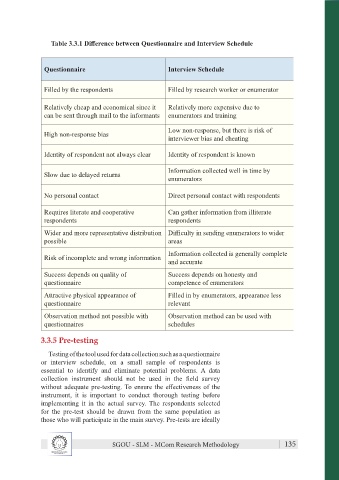
Table 3.3.1 Difference between Questionnaire and Interview Schedule


                 Questionnaire                              Interview Schedule


                 Filled by the respondents                  Filled by research worker or enumerator

                 Relatively cheap and economical since it   Relatively more expensive due to
                 can be sent through mail to the informants  enumerators and training


                                                            Low non-response, but there is risk of
                 High non-response bias
                                                            interviewer bias and cheating

                 Identity of respondent not always clear    Identity of respondent is known

                                                            Information collected well in time by
                 Slow due to delayed returns
                                                            enumerators


                 No personal contact                        Direct personal contact with respondents

                 Requires literate and cooperative          Can gather information from illiterate
                 respondents                                respondents

                 Wider and more representative distribution  Difficulty in sending enumerators to wider
                 possible                                   areas
                                                            Information collected is generally complete
                 Risk of incomplete and wrong information
                                                            and accurate

                 Success depends on quality of              Success depends on honesty and
                 questionnaire                              competence of enumerators

                 Attractive physical appearance of          Filled in by enumerators, appearance less
                 questionnaire                              relevant
                 Observation method not possible with       Observation method can be used with
                 questionnaires                             schedules

               3.3.5 Pre-testing

                  Testing of the tool used for data collection such as a questionnaire
               or interview schedule,  on a small  sample  of respondents is
               essential to identify and eliminate  potential  problems.  A data
               collection  instrument  should  not  be  used  in  the  field  survey
               without adequate pre-testing. To ensure the effectiveness of the
               instrument, it is important  to conduct thorough testing before
               implementing  it  in  the  actual  survey. The  respondents  selected
               for the pre-test should be drawn from the same population  as
               those who will participate in the main survey. Pre-tests are ideally


                                         SGOU - SLM - MCom Research Methodology                      135

