


Page 12 - SREENARAYANAGURU OPEN UNIVERSITY
P. 12
messages.  In  digital  communication,  words  tables.
               are often supplemented with emojis, stickers,
               memes, and gifs to share our emotions. These     Movies are a further example of audio-vi-
               being pictorial representations of our written   sual communication. The depth of ideas that
               messages,  they  often  help  us  to  communi-  can be communicated through combination of
               cate the emotion behind the idea better than   sounds and images is infinite. The advance in
               otherwise possible. Thus they are also a part   technology has made it possible for audio-vi-
               of non-verbal communication which is very      sual communication to be more realistic and
               important as it often supplements, bolsters, or   cheaper.  Anyone  with  a  smartphone/video
               replaces the verbal message altogether. We will   camera and a decent mic can now produce
               discuss non-verbal communication later in this   quality video content. This has revolutionised
               chapter.                                       the way we as a species communicate.


                  When we share our pictures and videos with   1�1�3 Non-Verbal Communication
               friends, family, and the public through social   Non-verbal communication, as mentioned
               media, we engage in visual and audio-visual  earlier,  takes  place  when  we  communicate
               communication.  Every image has the capacity  information  without  relying  on  written  or
               to speak and convey meanings. In newspapers  spoken language. The babble of babies is a
               and magazines, pictures are often included to  great example of this kind of communication.
               communicate the message more clearly and  Non-verbal communication is crucial in lend-
               also to increase the engagement of the reader.  ing depth of meaning to the message that is
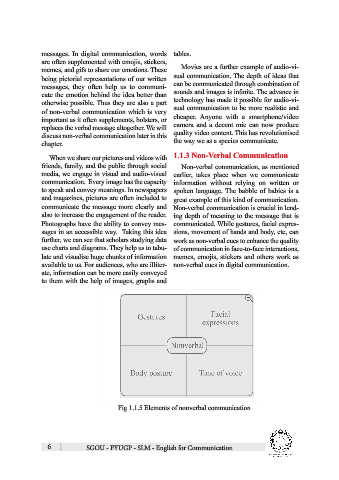
               Photographs have the ability to convey mes-    communicated. While gestures, facial expres-
               sages in an accessible way.  Taking this idea  sions, movement of hands and body, etc, can
               further, we can see that scholars studying data  work as non-verbal cues to enhance the quality
               use charts and diagrams. They help us to tabu-  of communication in face-to-face interactions,
               late and visualise huge chunks of information  memes, emojis, stickers and others work as
               available to us. For audiences, who are illiter-  non-verbal cues in digital communication.
               ate, information can be more easily conveyed
               to them with the help of images, graphs and


                                          Fig 1.1.5 Elements of nonverbal communication


                 6             SGOU - FYUGP - SLM - English for Communication

