


Page 10 - SREENARAYANAGURU OPEN UNIVERSITY
P. 10
We use casual language to communicate with  We will discuss formal and informal commu-
               them  as  there  would  be  a  continuous  flow  nication at length in the next unit.
               of ideas, thoughts, and emotions. These are
               expressed without any restraints. Communi-       For example, on Monday Jina is having a
               cation in a classroom, in contrast, is formal. It   meeting at  9 am in her office. So, she has to
               has a formal setting. During a seminar or con-  leave early for the office. We can imagine the
               ference, we maintain a decorum of language     following communication to be taking place
               and behaviour.  We can classify most forms of   between Jina and her mother on Sunday:
               communication as either formal or informal.


                              JINA: Mom, tomorrow I have a meeting in the morning.
                              MOM: Oh okay. When will you leave for office?
                              JINA: At 8. Can you please give me breakfast at 7:30?

                              MOM: Sure. I will prepare breakfast for you.

                  Here we can see two people, Jina and her  have nodded her head in response to Jina’s
               mother, in conversation. Jina is communicat-   first statement and Jina could have indicated
               ing her needs and informing her mother that  ‘tomorrow’ by waving her hands in a semi-cir-
               she has to leave early. They communicated by  cle.
               using words. There would have the possibility
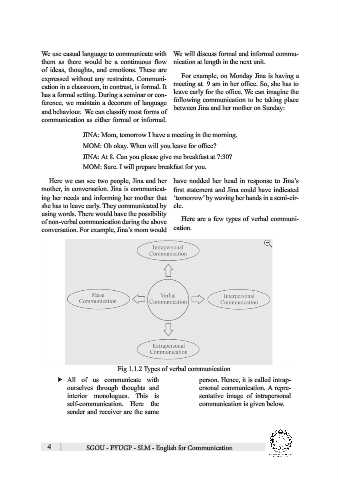
               of non-verbal communication during the above     Here are a few types of verbal communi-
               conversation. For example, Jina’s mom would    cation.


                                          Fig 1.1.2 Types of verbal communication
                     f   All  of  us  communicate  with                person. Hence, it is called intrap-
                        ourselves  through  thoughts  and              ersonal communication. A repre-
                        interior  monologues.  This  is                sentative  image  of  intrapersonal
                        self-communication.  Here  the                 communication is given below.
                        sender and receiver are the same


                 4             SGOU - FYUGP - SLM - English for Communication

