


Page 13 - SREENARAYANAGURU OPEN UNIVERSITY
P. 13
Verbal communication includes the usage  bally. For example, someone is asked if they
               of words, and it is even assisted by human  want to go out and says yes, and their gesture
               voices  or  letters.  Whereas,  nonverbal  com-  and body language suggests hesitation, it could
               munication is different as it refers to how you  mean  that  these  non-verbal  cues  contradict
               look,  gestures,  facial  expressions  and  body  what they have communicated verbally. Simi-
               postures communicate different meaning. But  larly, if someone is asked a question and they
               do nonverbal cues like gestures have a specific  simply nod or shakes their head, we can under-
               meaning at all?                                stand that the verbal message of yes or no is
                                                              substituted using a non-verbal cue. Finally, if
                  Nonverbal cues can be considered in terms   a person who is asked if they need tea shakes
               of emblems and illustrators.  Emblems are non-  their head and says no, they are employing
               verbal cues that have a universal meaning in   non-verbal cue to repeat and emphasise what
               our global culture.                            is communicated verbally.

                                                              1�1�4 Language

                                                                Have you ever thought of how language
                                                              originated?  There  is  not  any  theory  that
                                                              explains the origin of language. It occurred
                                                              thousands  of  years  ago  and  thus  remains

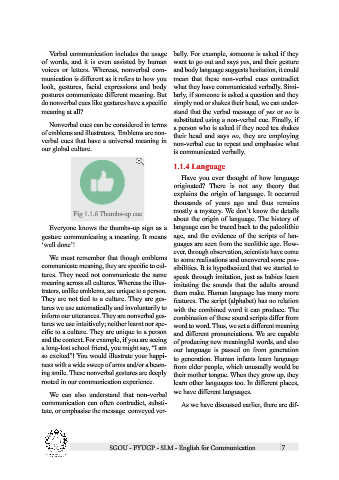
                           Fig 1.1.6 Thumbs-up cue            mostly a mystery. We don’t know the details
                                                              about the origin of language. The history of
                  Everyone knows the thumbs-up sign as a  language can be traced back to the paleolithic
               gesture communicating a meaning. It means  age, and the evidence of the scripts of lan-
               ‘well done’!                                   guages are seen from the neolithic age. How-
                                                              ever, through observation, scientists have come
                  We must remember that though emblems        to some realisations and uncovered some pos-
               communicate meaning, they are specific to cul-  sibilities. It is hypothesized that we started to
               tures. They need not communicate the same      speak through imitation, just as babies learn
               meaning across all cultures. Whereas the illus-  imitating  the  sounds  that  the  adults  around
               trators, unlike emblems, are unique to a person.   them make. Human language has many more
               They are not tied to a culture. They are ges-  features. The script (alphabet) has no relation
               tures we use automatically and involuntarily to   with the combined word it can produce. The
               inform our utterances. They are nonverbal ges-  combination of these sound scripts differ from
               tures we use intuitively; neither learnt nor spe-  word to word. Thus, we set a different meaning
               cific to a culture. They are unique to a person   and different pronunciations. We are capable
               and the context. For example, if you are seeing   of producing new meaningful words, and also
               a long-lost school friend, you might say, “I am   our  language  is  passed  on  from  generation
               so excited”! You would illustrate your happi-  to generation. Human infants learn language
               ness with a wide sweep of arms and/or a beam-  from elder people, which unusually would be
               ing smile. These nonverbal gestures are deeply   their mother tongue. When they grow up, they
               rooted in our communication experience.        learn other languages too. In different places,

                  We  can  also  understand  that  non-verbal   we have different languages.
               communication can often contradict, substi-      As we have discussed earlier, there are dif-
               tute, or emphasise the message  conveyed ver-


                                       SGOU - FYUGP - SLM - English for Communication               7

