


Page 9 - SREENARAYANAGURU OPEN UNIVERSITY
P. 9
in ancient Mesopotamia revolutionised human communication, enabling the recording
                   and dissemination of information across time and space. From cuneiform tablets to the
                   printing press, each technological advancement expanded the reach and impact of human
                   communication.

                      In the modern era, the pace of change in communication technology has accelerated
                   dramatically. The telegraph, telephone, radio, and television each brought new dimensions
                   to how we interact and share information. The digital revolution and the rise of the inter-
                   net have further transformed the landscape, creating a globally connected world where
                   information flows at unprecedented speeds.

                      Today, we stand at the threshold of new frontiers in communication, with emerging
                   technologies like virtual reality, artificial intelligence, and brain-computer interfaces prom-
                   ising to reshape how we connect and understand each other. As we explore these new
                   possibilities, it’s valuable to reflect on the fundamental principles that have guided human
                   communication throughout history.


                      Keywords

                 Verbal, Non-Verbal, Features, Language, Origin, Theories

               1�1�1 Human Communication: Ver-                communication, verbal and non-verbal com-
               bal and Non-verbal                             munication.  Non-verbal  communication  is

                  Communication, as we have experienced,      the exchange of information through non-lin-
                                                              guistic means, and verbal communication is
               is basically the process of sharing information.   exchanging information using words. Now let
               Language is a primary tool used for commu-     us learn what verbal and non-verbal commu-
               nication, but not all kinds of communication   nications are.
               rely on language. There two types of human


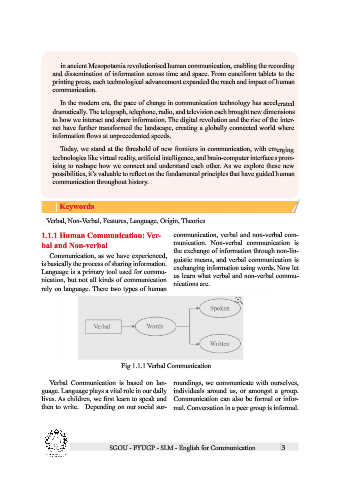
                                           Fig 1.1.1 Verbal Communication


                  Verbal  Communication  is  based  on  lan-  roundings, we communicate with ourselves,
               guage. Language plays a vital role in our daily  individuals around us, or amongst a group.
               lives. As children, we first learn to speak and  Communication can also be formal or infor-
               then to write.   Depending on our social sur-  mal. Conversation in a peer group is informal.


                                       SGOU - FYUGP - SLM - English for Communication               3

