


Page 27 - SREENARAYANAGURU OPEN UNIVERSITY
P. 27
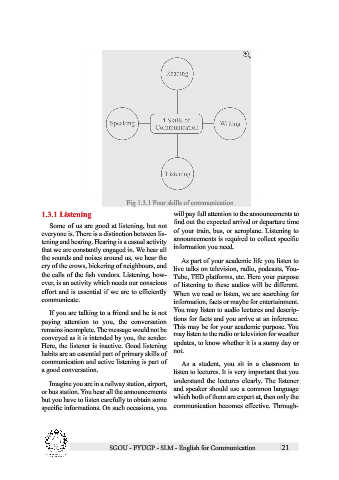
Fig 1.3.1 Four skills of communication

               1�3�1 Listening                                will pay full attention to the announcements to
                  Some of us are good at listening, but not   find out the expected arrival or departure time
               everyone is. There is a distinction between lis-  of your train, bus, or aeroplane. Listening to
               tening and hearing. Hearing is a casual activity   announcements is required to collect specific
               that we are constantly engaged in. We hear all   information you need.
               the sounds and noises around us, we hear the     As part of your academic life you listen to
               cry of the crows, bickering of neighbours, and   live talks on television, radio, podcasts, You-
               the calls of the fish vendors. Listening, how-  Tube, TED platforms, etc. Here your purpose
               ever, is an activity which needs our conscious   of listening to these audios will be different.
               effort and is essential if we are to efficiently   When we read or listen, we are searching for
               communicate.                                   information, facts or maybe for entertainment.

                  If you are talking to a friend and he is not   You may listen to audio lectures and descrip-
               paying  attention  to  you,  the  conversation   tions for facts and you arrive at an inference.
               remains incomplete. The message would not be   This may be for your academic purpose. You
               conveyed as it is intended by you, the sender.   may listen to the radio or television for weather
               Here, the listener is inactive. Good listening   updates, to know whether it is a sunny day or
               habits are an essential part of primary skills of   not.
               communication and active listening is part of    As  a  student,  you  sit  in  a  classroom  to
               a good conversation.                           listen to lectures. It is very important that you

                  Imagine you are in a railway station, airport,   understand the lectures clearly. The listener
               or bus station. You hear all the announcements   and speaker should use a common language
               but you have to listen carefully to obtain some   which both of them are expert at, then only the
               specific informations. On such occasions, you   communication becomes effective. Through-


                                       SGOU - FYUGP - SLM - English for Communication               21

